“The installation is an interactive audiovisual installation that represents an imaginary garden composed by memories, a virtual entity composed of selected audiovisual material. A digitally edited map with position sensors under it, is placed on the floor of the exhibition area. The “map” which constitutes the projection screen of the visual material, defines the place that the user explores both visually and auditory while walking. As a result, based on the viewer’s body position on the map, different narrations and soundscapes are composed depending on the way the parts of the audio-visual archive are being related to each other by the code’s repeating executions. Using an audiovisual archive involving fragmented memories related to a network of different locations and times, the aim is to explore the way digital memory and consequently perception is formed in relation to the viewer’s positions.”
1 INTRODUCTION The interactive installation negotiates concepts such as garden, memory, map, and the relative viewer’s position in space (Fig. 1). Each step of the viewer on a network of sensors, provides a different composition of the audio and visual parts of the archive, a different formation of digital memory (Fig. 2). Audio and visual recordings related to the temporal and spatial identities of various “gardens” Permission to make digital or hard copies of all or part of this work for personal or classroom use is granted without fee provided that copies are not made or distributed for profit or commercial advantage and that copies bear this notice and the full citation on the first page. Copyrights for components of this work owned by others than ACM must be honored. Abstracting with credit is permitted. To copy otherwise, or republish, to post on servers or to redistribute to lists, requires prior specific permission and/or a fee. Request permissions from permissions@acm.org.
https://doi.org/10.1145/3483529.3483739
create constant new narrations and interpretations. Different atmospheres that constitute the virtual entity of the garden are revealed and various conflicting elements that make it up are highlighted.
1.1 The garden The definition of the term garden stands is abstract since it is related to different interpretations that have been given by the various cultures, such as the Japanese dry landscapes [1] as well as by various philosophers. We all have a personal idea of what a garden is. A garden might be the imprint of the collaboration of nature with art within the urban space, an area of contemplative pause of urban life where wasted time finds its meaning, an in between space with social, cultural, and psychotherapeutic dimensions to which every historical period and every culture have given their own distinct meanings. In the case of the installation, the transfer of the concept of the garden to the virtual space acquires new meaning related to but also extending those in real space. The virtual version is a space of cultivation, entropy, and conservation of memories in which opposing elements coexist and create elusive atmospheres. By using an archive of audio and video recordings as well as an operational system involving “obsolete” software in the process of its implementation, the installation both as context and as an operational system, concerns a trace of the past in the present.
1.2 Reconstructing Memory
Technical memory in digital culture is an active process which characterized by “its conflation with storage, which produces the odd, almost paradoxical idea of enduring ephemerality”. As Ernst claims it is not so much a place of rest but part of a wider setting of calculation (working memory)”. [3] “But today’s digital fusion of network and archive ushers in a hyperconnectivity, namely ‘a new shaper of patterns of experience both synchronic and diachronic, forging and reforging new assemblages of remembering and forgetting’ (Hoskins and Tulloch 2016,9)”. [3]. The micro archive of the audio-visual material which composes the virtual material of the interactive installation includes various digitally recorded memories. “The digital does reveal alien and unpalatable memories, but it also transcends the time of now and then, reconnecting, reimagining and reconstituting the past as network, as archive, as present”. [2] By the various combinations of the projected shots and consequently the produced different sequences of fragmented memories, memory is separated and released from its spatial and temporal boundaries, is reconstructed, reimagined, and reconstituted.
1.3 The Map
The map positioned on the floor is not a geographical representation but an imprint of the fragmented space that defines the fie
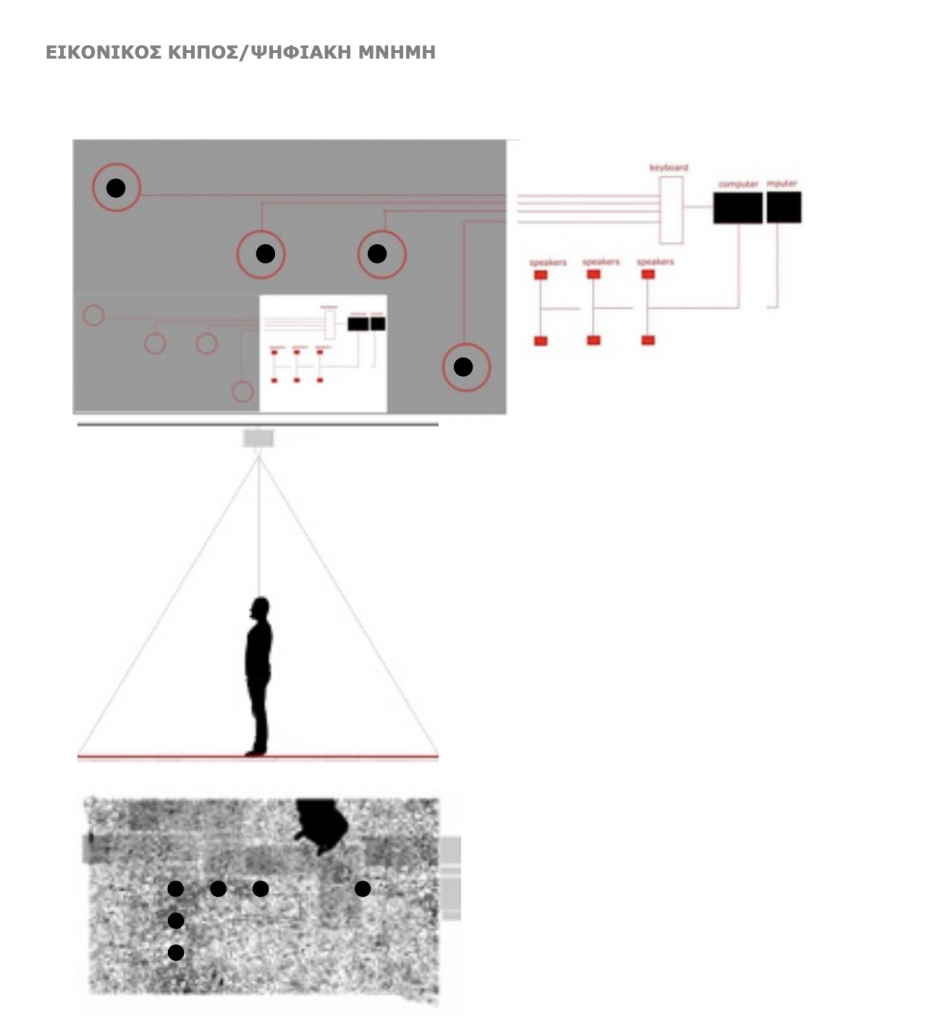
The interactive audiovisual installation is a short of a journey into a mesmerizing, memory-laden wonderland. This project, an “imaginary garden” composed of recollections and fragmented experiences, invites viewers to engage with digital memory in a way that blurs the lines between art, technology, and the human experience. This immersive installation transforms the act of walking into an exploration of memory, sound, and image, where every step takes you deeper into a realm where past and present, real and imagined, coexist in an intricate dance. At the heart of the installation lies a digital map, positioned on the exhibition floor, which becomes both the visual canvas and the foundation for this virtual garden. However, this is no ordinary map; it is a dynamic interface that interacts with the audience in real-time. As visitors walk across the map, their body position triggers sensors beneath, creating a constantly shifting narrative landscape. Each movement leads to a new visual and auditory experience, generated by the intricate relationship between the participant’s steps and the pre-programmed audiovisual archive that defines the space. The installation essentially turns each viewer into a composer, orchestrating their own personal journey through a personal curated collection of memories. The audiovisual material presented isn’t static or predictable. Instead, it is a living, breathing entity—a patchwork of fragmented memories drawn from a variety of locations and times. These snippets of the past weave together in ever-changing combinations as the installation’s underlying code executes repeatedly, ensuring that no two experiences are alike. Bouzas has crafted a delicate interplay between digital memory and human perception, challenging viewers to question how memories are formed, reshaped, and experienced through the lens of technology. The soundscapes that envelop the space are just as vital to the installation as the visuals. As participants explore the virtual map, different sound environments emerge depending on their position. These auditory experiences layer memories with a sense of place, guiding participants into an introspective reflection on how sound and memory are intertwined in shaping our perception of the world. The effect is almost dreamlike: the installation envelops visitors in a cloud of sensory data, composed of echoes from different places and times, as if they are walking through a digital representation of the collective human consciousness. By using fragmented and reassembled audiovisual material, the installation mirrors how our own memories work: they are never whole, but rather collections of moments pieced together to form a narrative. The installation’s map symbolizes the intricate networks of connections between different locations, times, and experiences, representing how our memories are never isolated—they are always part of a larger, interconnected web. As the code continuously reshuffles the visual and auditory material, Bouzas cleverly mimics the process of memory formation and reformation, underscoring the fluidity of perception in a digital world. The installation stands as a poetic exploration of digital memory and human experience, a space where participants are encouraged to lose themselves in the ephemeral, fleeting, and ever-evolving nature of perception. Bouzas has cultivated a truly unique and engaging space—a garden not of flowers, but of memories—where each step leads deeper into a world of introspection and discovery.